
Stolen Focus? Go Analog.
Mini book review. No Phone. Writing by Hand. Breathing.

Coaches Corner - Quick Summary
Powerful, most often digital,forces want to steal your attention.
“Stolen Focus” is a great book describing this.
Returning to the Analog: more time with zero phone, writing by hand, reading paper, touching grass are great antidotes to this.
Changing BrAIn
I have been working with AI quite a bit.
Building projects and agents and pulling stuff of GitHub and installing Python and a number of things that I have never done before.
It’s amazing, a dash frightening, and I think my brain is changing shape in real time.
The agreeability of the models. The endless patience. The synthetically human responses. The endless praise for my random and often mundane observations.
All of these resulting in what I think could be called “AI Brain”.
A squishier, less sharp, version of my brain.
Impact: struggling to finish posting here. Struggling to complete my thoughts. Seems like I can start and get to 75% but the last 25% has been elusive.
…until I changed the start to my day and went totally analog.
Struggling to Stay Focused
Thing is, even before the AI stuff, I was noticing an impact to my capacity to focus for long stretches.
I love podcasts and audiobooks and music generally. So I was often “plugged in” listening at 2x speed to pound more stuff into my brain.
To find the answers!
In doing so, I became a bit addicted, aka totally addicted, to consuming. At the same time, I struggled to remember much of what I was actually consuming.
A recent post from Cate Hall spoke truth to this…
Something I have recently changed my mind about: the ROI on all those podcasts is terrible.
My time is valuable and scarce.
My attention is priceless.
My phone is here to steal both.
Stolen Focus
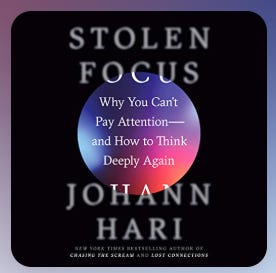
Highly recommend this book by Johann Hari
Central Claim: the attention crisis isn’t a personal failing it’s a systemic problem fuelled by poor incentives.
Apps, food, the sheer volume of information available, and the fight for our attention, our “engagement”, has created a world that our biology can’t contend with.
Stealing Attention: business models are built around getting and keeping our attention. There is a huge cost of switching tasks, of switching our focus.
We seldom have time to be bored and let our minds wander, which impairs our creativity. Sleep is critical and often over looked. The speed of information and life has increased thus devaluing a slower approach.
What Helps: flow states are the goal yet require removing distractions BEFORE they happen. Planning ahead. Pre-commitment over willpower (ex. leave the phone in another room) is worth it.
Plan and protect time to be bored. Read long form. Read fiction. Get good sleep! Pay attention to what you are really curious about.
In sum, being more focused has huge benefits and it requires us to be more focused.
How do we create that?
Going Analog
I am a morning person and I set my day with a morning routine.
Which I highly recommend because it works well for me, and apparently it worked for Marcus Aurelius…
From the Daily Stoic:
“How will you spend your day? How will you spend your morning? Because how you spend your morning and how you spend your days is of course how you will spend your life.”
“Own the morning, own the day.” - Ryan Holiday
Marcus’s Daily Routine = Analog
Journal
Physical exercise: walking, lifting, boxing.
Nature: touch the grass, get outside, see the sun.
Cold exposure
Converse with others
Practice seeing the mundane, appreciating simplicity.
Then go to work.
Analog in a Digital World
Adding to Marcus’s routine are a few modern opportunities.
1. No Phone means No Phone.
No music. No podcasts. Nothing.
Leave it in another room at the start and end of your day.
For an hour.
Enjoy the silence.
Impact: this was hard to implement and has been a substantial improvement. There is no artificial “inbound” coming into my brain. I actually get a chance to experience my thoughts, and how random they are. To understand what I think.
To allow answers to arrive, to ask better questions.
2. Writing by hand, on paper, for at least 15 minutes
A version of morning pages.
Impact: this has had a huge impact on decluttering my brain. I feel restored after this process. It’s a random string of whatever comes to mind. No rules, no intent, no plans to save or re-read what is written.
It seems to clear out the space in my brain.
3. Breathe
Impact: having a daily breath practice helps me shift more fully into my body, get out of my head.
Benefits of the Analog
The impact has been significant.
My brain is sharper.
I can gather my thoughts, write them out, and get to a place where this might be worth posting.
Crucially, I can work with AI and still get my thoughts out in other places.
Any other ideas you’ve had success with?
Is there something above you are willing to try out?
Highly Recommended Read/Listen…
The Core Argument
Hari’s central claim is that the attention crisis isn’t a personal failing — it’s a systemic problem engineered by powerful forces. We’ve been sold the story that we’re distracted because we lack willpower or discipline, but the evidence points elsewhere: our environment has been redesigned to fragment our focus, and it’s working exactly as intended.
Why Our Attention Is Being Stolen
The tech industry’s business model. Social media platforms are built around “engagement,” which is really just another word for captured attention. The longer they hold your eye, the more ad revenue they generate. So they hire the best behavioral scientists in the world to figure out how to keep you scrolling. Variable reward loops (like slot machines), outrage algorithms, and infinite scroll are all deliberate design choices — not accidents.
The switch cost effect. Every time you switch tasks — from deep work to a notification, then back — your brain pays a tax.
Studies Hari cites suggest it takes an average of 23 minutes to fully return to a state of focus after an interruption. Most of us interrupt ourselves every few minutes, meaning we almost never reach deep concentration at all.
The collapse of mind-wandering. One of the most interesting points in the book:
Boredom and mind-wandering aren’t empty states, they’re when your brain consolidates memories, generates creative insight, and makes meaning.
By filling every idle moment with our phones, we’ve essentially starved that process.
Sleep deprivation. Hari dedicates significant space to sleep as a foundation for attention. Screens before bed suppress melatonin and compress the sleep stages where memory and attention are restored. We’re running chronically depleted.
Diet, environment, and childhood development. He goes broader than most books on this topic — connecting attention problems to ultra-processed food, reduced free play in childhood, and increasing childhood stress. These aren’t just lifestyle notes; he frames them as systemic failures.
The speed of everything. Books, articles, conversations — everything has sped up. Hari argues we’ve culturally devalued the slow, patient attention that deep reading and long-form thought require.
Strategies and What Actually Helps
Hari is honest that individual solutions are partial — he’s clear that the full fix requires collective and political action (regulating attention-harvesting business models).
But in the meantime:
Flow states are the goal. Getting into deep, absorbed attention (what Csikszentmihalyi called “flow”) is both the antidote and the reward. You get there by removing distractions before they happen, not by fighting them in the moment.
Pre-commitment over willpower. Rather than relying on in-the-moment restraint, remove the option. Phone in another room, app blockers, phone-free hours.
Willpower is unreliable; environment design is durable.
Protect unstructured time. Deliberately doing nothing — walks without podcasts, sitting without a phone — reactivates the default mode network and restores creative and reflective capacity.
Read long-form. Hari is a strong advocate for books specifically, not just as content but as attention training. The act of following a long argument for hours rebuilds the cognitive muscle.
Sleep as a non-negotiable. Getting 7–9 hours, protecting the last hour before bed from screens, and treating sleep as an attention intervention rather than a luxury.
Reconnect with intrinsic motivation. When we’re pulled by genuine curiosity or meaning rather than pushed by notifications, our attention is naturally more sustained and less fragmented.
Collective solutions. Hari ends with a vision of political action — pushing for regulation of manipulative design practices the way we regulate cigarettes. Individual change alone, he argues, is like trying to lose weight while food companies can market junk food to your kids.
Love the thoughts Kris! Curious if you have had a chance to add an old school alarm clock to your bedroom, or if you rely on your phone to tell the time at night? I switched over to a 90s digital clock a while ago, and I reckon not having to look at my phone to tell the time helped improve my sleep!